
Lusi Purple French Lavender Plants
- Variety: Lusi Purple
- Species: Lavandula pedunculata subsp. lusitanica (French lavender / Butterfly lavender)
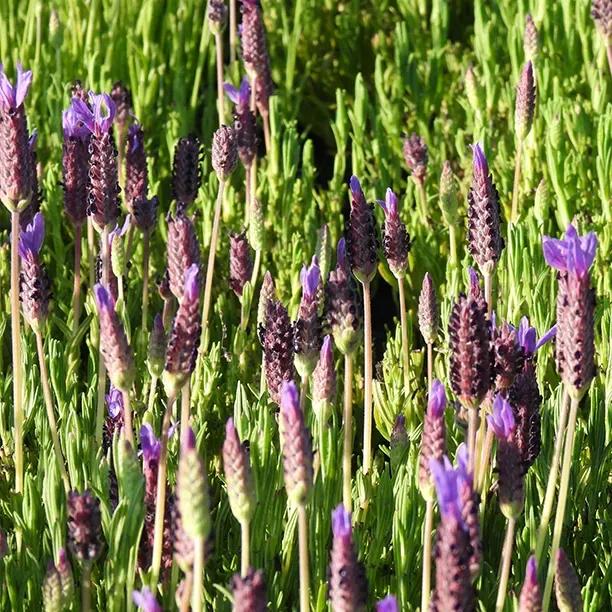
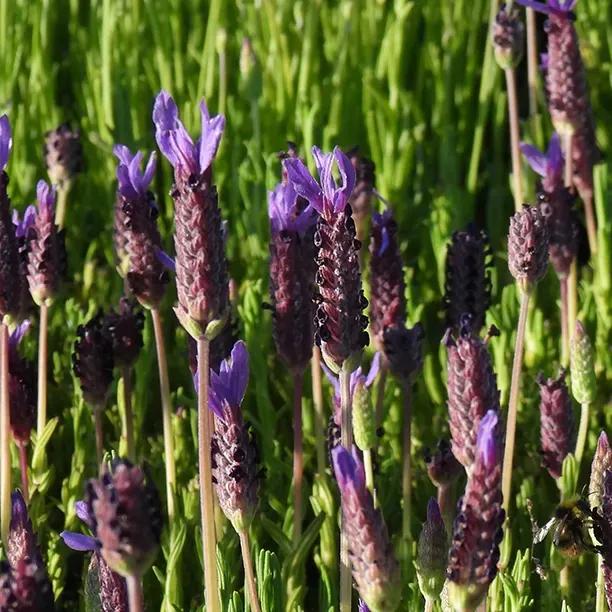
- Colour: Deep purple-blue with prominent violet "ears" (bracts) at the top of each flower head
- Foliage: Evergreen, aromatic, grey-green with a slightly resinous scent
- Height: Around 40cm (16in)
- Spread: 30–40cm (12–16in)
- Flowering: May to September — the longest season of any lavender sub-species, often starting before English varieties have opened
- Scent: Aromatic but resinous, with a pine-like edge. Not for cooking — strictly decorative and for scent in the garden
- Hardiness: Borderline hardy in the UK. Fine in southern and coastal gardens; needs a sheltered spot or pot culture further north. Will not survive prolonged cold wet soil
- RHS AGM: No
- Introduced: Selected from Lavandula pedunculata subsp. lusitanica, native to Portugal and western Iberia
- Sold as: Pot-grown plants (P9)
- Plant outdoors: From mid-May onwards, once the risk of late frost has passed. In northern England and Scotland, consider permanent pot culture
- Delivered: From May, weather dependent
Lusi Purple — The Smallest Lavender with the Biggest Personality
Most lavenders look more or less like lavender. Lusi Purple does not. The fat, pineapple-shaped flower heads sit on short stems and each one is topped with a pair of upright purple bracts — the "ears" or "wings" that give butterfly lavenders their common name. The colour is a concentrated deep purple-blue, darker than the standard French butterfly lavender, and the whole plant is compact enough to sit happily in a pot on a doorstep or a sunny windowsill. At roughly 40cm, it is the most compact lavender we sell.
The catch — and we should be honest about this — is hardiness. Lusi Purple belongs to Lavandula pedunculata subsp. lusitanica, a sub-species native to Portugal and the sandy heaths of western Iberia. It wants hot, dry summers and mild, damp (not cold-wet) winters. In southern England, a sheltered gravel garden or a raised bed against a south-facing wall will usually be enough. In the Midlands and further north, a decent terracotta pot that you can move under cover in November is the more reliable option. We have had plants sail through mild winters here in Somerset, and we have lost others when a late March freeze caught them after they had already started growing. That is the deal with French lavenders: they give you colour from May until September, but they ask for a bit more thought about where you put them.
Portuguese Roots, English Pots
The "Lusi" in the name is a clue. Lavandula pedunculata subsp. lusitanica takes its Latin name from Lusitania — the old Roman province that covered most of modern Portugal. In the wild, these plants grow on dry, acidic, sandy hillsides, often alongside Cistus and low-growing heathers. The soil is poor and fast-draining, and the winters are cool but rarely freezing for long. That tells you everything you need to know about growing Lusi Purple in the UK: sharp drainage matters more than anything else. A gritty, free-draining compost (John Innes No. 2 mixed 50/50 with horticultural grit) in a terracotta pot is close to ideal. In open ground, dig in plenty of grit at planting time and avoid any spot where water sits in winter. Clay soil without serious amendment is a death sentence.
One thing that surprises people: Lusi Purple starts flowering weeks before English lavenders. In a warm May, you can have colour while Hidcote is still just silver buds. And it keeps going. Deadhead regularly and it will produce new flower heads right through to September, sometimes into October if autumn stays mild. No English lavender can match that season length.
Planting Companions
Lusi Purple looks best with other Mediterranean sun-lovers that share its need for drainage. Rosemary is a natural neighbour — similar foliage colour, similar soil preferences, and the upright rosemary habit contrasts well with the low, mounding shape of Lusi Purple. In a large pot or trough, try it alongside Erigeron karvinskianus (Mexican fleabane) for a tumbling, informal effect. Thyme, Santolina, and Cistus all work in the ground. Stand a pot of Lusi Purple in front of a taller Phenomenal or Grosso and you get the butterfly ears at ankle height with the tall Lavandin spikes behind — two completely different lavender shapes together.
Why Buy from Ashridge?
Your Lusi Purple lavender is grown here in the UK and dispatched when conditions are right for planting — we will not send tender plants into a cold snap. Delivery is by next-day courier, every plant is guaranteed, and our team of gardeners here in Somerset is on hand for advice if you need it. Browse our full French lavender collection or see all our lavender plants. We are a Feefo Platinum Service Award holder — earned by real customer reviews, not by us.
Frequently Asked Questions
Our blog on growing lavender covers the full picture for all types. Below are the questions we hear most often about Lusi Purple.
What is the difference between English and French lavender?
English lavender (Lavandula angustifolia) is fully hardy, has a sweet scent, and flowers in June and July on narrow spikes. French and butterfly lavenders (Lavandula stoechas and pedunculata types) are only borderline hardy in the UK, have a more resinous, pine-like scent, and produce those distinctive "eared" flower heads over a much longer season — typically May to September. English lavenders are better for cooking and drying. French lavenders are better for sheer length of display and for that exotic, slightly wild look. Both want full sun and good drainage.
Can lavender grow in clay soil?
English lavenders and Lavandins can cope with improved clay — dig in sharp grit and organic matter to break up the structure and raise the planting area slightly. Lusi Purple, though, is a different matter. Its Portuguese ancestry means it really does need fast-draining, lean soil. On heavy clay, grow it in a pot with gritty compost. Trying to force it into waterlogged ground over winter is a battle you will not win.
Does lavender keep mosquitoes away?
There is some evidence that the essential oils in lavender foliage deter mosquitoes and other biting insects, and French lavenders like Lusi Purple have a particularly pungent resinous oil. Whether a single pot on your patio will keep them at bay on a warm evening is another question. Crushing a few leaves and rubbing them on your skin probably does more than simply having the plant nearby. It is not a guarantee, but it is better than nothing — and it smells a lot nicer than DEET.
Can I grow lavender from cuttings?
Certainly. Semi-ripe cuttings taken in late summer (August or September) root well in a gritty compost with a clear plastic bag over the top to keep humidity up. Take shoots about 8–10cm long, strip the lower leaves, dip in rooting hormone, and push them into a pot of 50/50 perlite and compost. Lusi Purple roots readily this way, and since French lavenders can be shorter-lived than English varieties, taking a few cuttings each year is good insurance against winter losses.
Is lavender safe for cats and dogs?
Lavender is generally considered non-toxic to cats and dogs, and most animals leave it alone — the strong scent puts them off. Concentrated lavender essential oil is a different story and can be harmful to cats in particular, so keep neat oil away from pets. The plant itself, growing in a pot or garden, is not a worry. The ASPCA lists lavender as mildly toxic if eaten in large quantities, but in practice, no sensible cat is going to munch through a whole lavender bush. The resinous taste of French lavender is especially off-putting.
Original: $6.55
-70%$6.55
$1.96Product Information
Product Information
Shipping & Returns
Shipping & Returns
Description
- Variety: Lusi Purple
- Species: Lavandula pedunculata subsp. lusitanica (French lavender / Butterfly lavender)
- Colour: Deep purple-blue with prominent violet "ears" (bracts) at the top of each flower head
- Foliage: Evergreen, aromatic, grey-green with a slightly resinous scent
- Height: Around 40cm (16in)
- Spread: 30–40cm (12–16in)
- Flowering: May to September — the longest season of any lavender sub-species, often starting before English varieties have opened
- Scent: Aromatic but resinous, with a pine-like edge. Not for cooking — strictly decorative and for scent in the garden
- Hardiness: Borderline hardy in the UK. Fine in southern and coastal gardens; needs a sheltered spot or pot culture further north. Will not survive prolonged cold wet soil
- RHS AGM: No
- Introduced: Selected from Lavandula pedunculata subsp. lusitanica, native to Portugal and western Iberia
- Sold as: Pot-grown plants (P9)
- Plant outdoors: From mid-May onwards, once the risk of late frost has passed. In northern England and Scotland, consider permanent pot culture
- Delivered: From May, weather dependent
Lusi Purple — The Smallest Lavender with the Biggest Personality
Most lavenders look more or less like lavender. Lusi Purple does not. The fat, pineapple-shaped flower heads sit on short stems and each one is topped with a pair of upright purple bracts — the "ears" or "wings" that give butterfly lavenders their common name. The colour is a concentrated deep purple-blue, darker than the standard French butterfly lavender, and the whole plant is compact enough to sit happily in a pot on a doorstep or a sunny windowsill. At roughly 40cm, it is the most compact lavender we sell.
The catch — and we should be honest about this — is hardiness. Lusi Purple belongs to Lavandula pedunculata subsp. lusitanica, a sub-species native to Portugal and the sandy heaths of western Iberia. It wants hot, dry summers and mild, damp (not cold-wet) winters. In southern England, a sheltered gravel garden or a raised bed against a south-facing wall will usually be enough. In the Midlands and further north, a decent terracotta pot that you can move under cover in November is the more reliable option. We have had plants sail through mild winters here in Somerset, and we have lost others when a late March freeze caught them after they had already started growing. That is the deal with French lavenders: they give you colour from May until September, but they ask for a bit more thought about where you put them.
Portuguese Roots, English Pots
The "Lusi" in the name is a clue. Lavandula pedunculata subsp. lusitanica takes its Latin name from Lusitania — the old Roman province that covered most of modern Portugal. In the wild, these plants grow on dry, acidic, sandy hillsides, often alongside Cistus and low-growing heathers. The soil is poor and fast-draining, and the winters are cool but rarely freezing for long. That tells you everything you need to know about growing Lusi Purple in the UK: sharp drainage matters more than anything else. A gritty, free-draining compost (John Innes No. 2 mixed 50/50 with horticultural grit) in a terracotta pot is close to ideal. In open ground, dig in plenty of grit at planting time and avoid any spot where water sits in winter. Clay soil without serious amendment is a death sentence.
One thing that surprises people: Lusi Purple starts flowering weeks before English lavenders. In a warm May, you can have colour while Hidcote is still just silver buds. And it keeps going. Deadhead regularly and it will produce new flower heads right through to September, sometimes into October if autumn stays mild. No English lavender can match that season length.
Planting Companions
Lusi Purple looks best with other Mediterranean sun-lovers that share its need for drainage. Rosemary is a natural neighbour — similar foliage colour, similar soil preferences, and the upright rosemary habit contrasts well with the low, mounding shape of Lusi Purple. In a large pot or trough, try it alongside Erigeron karvinskianus (Mexican fleabane) for a tumbling, informal effect. Thyme, Santolina, and Cistus all work in the ground. Stand a pot of Lusi Purple in front of a taller Phenomenal or Grosso and you get the butterfly ears at ankle height with the tall Lavandin spikes behind — two completely different lavender shapes together.
Why Buy from Ashridge?
Your Lusi Purple lavender is grown here in the UK and dispatched when conditions are right for planting — we will not send tender plants into a cold snap. Delivery is by next-day courier, every plant is guaranteed, and our team of gardeners here in Somerset is on hand for advice if you need it. Browse our full French lavender collection or see all our lavender plants. We are a Feefo Platinum Service Award holder — earned by real customer reviews, not by us.
Frequently Asked Questions
Our blog on growing lavender covers the full picture for all types. Below are the questions we hear most often about Lusi Purple.
What is the difference between English and French lavender?
English lavender (Lavandula angustifolia) is fully hardy, has a sweet scent, and flowers in June and July on narrow spikes. French and butterfly lavenders (Lavandula stoechas and pedunculata types) are only borderline hardy in the UK, have a more resinous, pine-like scent, and produce those distinctive "eared" flower heads over a much longer season — typically May to September. English lavenders are better for cooking and drying. French lavenders are better for sheer length of display and for that exotic, slightly wild look. Both want full sun and good drainage.
Can lavender grow in clay soil?
English lavenders and Lavandins can cope with improved clay — dig in sharp grit and organic matter to break up the structure and raise the planting area slightly. Lusi Purple, though, is a different matter. Its Portuguese ancestry means it really does need fast-draining, lean soil. On heavy clay, grow it in a pot with gritty compost. Trying to force it into waterlogged ground over winter is a battle you will not win.
Does lavender keep mosquitoes away?
There is some evidence that the essential oils in lavender foliage deter mosquitoes and other biting insects, and French lavenders like Lusi Purple have a particularly pungent resinous oil. Whether a single pot on your patio will keep them at bay on a warm evening is another question. Crushing a few leaves and rubbing them on your skin probably does more than simply having the plant nearby. It is not a guarantee, but it is better than nothing — and it smells a lot nicer than DEET.
Can I grow lavender from cuttings?
Certainly. Semi-ripe cuttings taken in late summer (August or September) root well in a gritty compost with a clear plastic bag over the top to keep humidity up. Take shoots about 8–10cm long, strip the lower leaves, dip in rooting hormone, and push them into a pot of 50/50 perlite and compost. Lusi Purple roots readily this way, and since French lavenders can be shorter-lived than English varieties, taking a few cuttings each year is good insurance against winter losses.
Is lavender safe for cats and dogs?
Lavender is generally considered non-toxic to cats and dogs, and most animals leave it alone — the strong scent puts them off. Concentrated lavender essential oil is a different story and can be harmful to cats in particular, so keep neat oil away from pets. The plant itself, growing in a pot or garden, is not a worry. The ASPCA lists lavender as mildly toxic if eaten in large quantities, but in practice, no sensible cat is going to munch through a whole lavender bush. The resinous taste of French lavender is especially off-putting.